Event 1
Bataille de Waterloo
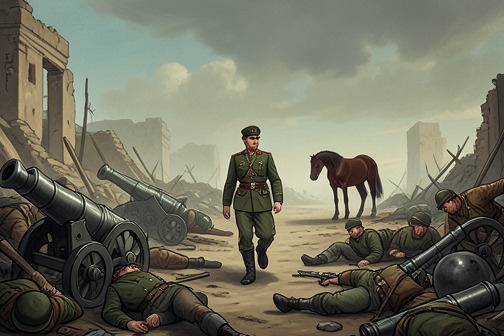
[Bataille de Waterloo](entity:event-recall-event-bataille-de-waterloo-be1f7009d59c) is both a historical turning point and a concealed hinge in Les Misérables: its defeat of [Napoléon Ier](entity:character-recall-character-488a6b238464)’s armies ends an imperial era, while its aftermath binds [George Pontmercy](entity:character-recall-character-george-pontmercy-d2ca77bd9771), [Thénardier](entity:character-recall-character-th-nardier-8f5d75d7f972), and [Marius Pontmercy](entity:character-recall-character-marius-pontmercy-9bc1a3cdf541) through a mistaken account of rescue. The battle is presented chiefly through historical framing, a father’s written recollection, and its lingering signs in the world around the characters, rather than through a narrated account of combat.
## Historical Setting and Consequence
The novel places [Waterloo](entity:location-recall-location-86ee709f431c) in June 1815, when the armies of Napoléon Ier were defeated by the English and the Prussians. The defeat compelled the Emperor to abdicate and announced the fall of the [First French Empire](entity:time-recall-time-first-french-empire-02444eeaec94). In the book’s wider historical sweep, the battle stands at one end of a movement toward the popular insurrections of June 1832, which threaten the [July Monarchy](entity:time-recall-time-9d8fa81851ed). Waterloo is therefore not simply a remote date: it marks a political order’s collapse before the novel turns to later upheavals and a society in change.
The battle also functions as an origin point for private histories. George Pontmercy emerges from it as a survivor and as a former imperial officer, while the story of what happened to him becomes part of his son’s inheritance. The novel’s broad historical account and its intimate family plot meet at this point: the end of an empire leaves behind a father whose title, political loyalties, and unfinished request will shape [Marius](entity:character-recall-character-b27b39bc4812)’s understanding of him.
## Pontmercy’s Survival and the Thénardier Connection
George Pontmercy is identified as a hero of the Empire who became a colonel and baron under Napoléon Ier. He survives the Battle of Waterloo, but his later account gives Thénardier a place in that survival. In a note addressed to his son, Pontmercy says that a sergeant named Thénardier saved his life at Waterloo. He asks Marius to do whatever good he can for that man if they meet. The request turns a battlefield encounter into a moral obligation intended to pass from father to son.
The novel makes that inherited obligation rest on a mistaken understanding. Pontmercy believes that Thénardier saved him; the account of the wounded colonel at Waterloo instead identifies Thénardier as attempting to rob him. The contrast separates what Pontmercy thinks he owes from what Thénardier actually did. It also gives the battle’s legacy an ironic shape: an act of exploitation is remembered as a rescue, and that false memory becomes a reason for Marius to seek out and assist the man.
The story of this connection reaches the reader through aftermath rather than a set-piece battle scene. The surviving evidence is concentrated in Pontmercy’s recollection and his written instruction, which carry the battlefield into the later family narrative. The physical danger of the encounter matters, but so does the uncertainty of how it was understood: the supposed debt survives because the father’s version is preserved for his son.
## A Title and a Father’s Last Request
Pontmercy’s note links his military service to his title. He writes that Napoléon Ier made him a baron on the battlefield of Waterloo, and that, because the Restoration disputes a title he paid for with his blood, his son should take and bear it worthily. The title is not merely a decoration in this account. It represents a claim to public recognition rooted in service, set against the political order that followed the Empire.
For Marius, however, the note initially carries an emotional burden rather than a settled filial devotion. He does not love his father and feels remorse about that estrangement. After Pontmercy’s death, the sale of the household furnishings barely pays for the funeral; a servant finds the paper and gives it to Marius. He keeps it, not because he has suddenly become religiously devoted to his father, but because death gives the request an authority he cannot easily dismiss. Waterloo’s consequences thus reach Marius through two inheritances: the contested baronial name and the charge to repay Thénardier.
## The Battle’s Image in the Novel
Waterloo leaves a visible, if distorted, trace at the Thénardiers’ establishment in [Montfermeil](entity:location-recall-location-af0fe167b616), near [Paris](entity:location-recall-location-657453741ed3). In 1818, the inn bears a painted sign showing a man carrying another man whose epaulettes suggest a general. Red marks represent blood; smoke fills the rest of the image. Beneath it is the name of the Waterloo sergeant. The sign turns the battle into a local emblem, but its crude, theatrical picture offers no reliable account of what happened between the two men. Its heroic appearance stands sharply against the later revelation that the supposed rescuer tried to rob the wounded Pontmercy.
The novel also identifies Waterloo as an influence on Victor Hugo in shaping the work. Its importance consequently exceeds the battlefield’s place in the characters’ past: it supplies historical scale, a source of personal misrecognition, and an image that recurs in the everyday setting of an inn. Through the distance between military glory and the Thénardiers’ sign, and between Pontmercy’s belief and Thénardier’s conduct, Waterloo’s aftermath becomes a test of how history is remembered, inherited, and used.
Event 2
Bataille d’Hernani
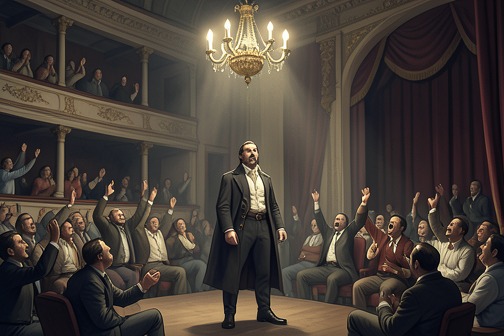
The [Bataille d’Hernani](entity:event-recall-event-bataille-d-hernani-31de85e5c92c) was the heated theatrical reception of Victor Hugo’s *Hernani* in 1830. Both a performance and a cultural confrontation, it turned the play’s success into a defining public demonstration of Romanticism’s challenge to established literary forms.
## Background
By the time *Hernani* was performed, Hugo had already set out a case for artistic freedom in the preface to his play *Cromwell* (1827), a work regarded as marking the birth of Romantic drama. He was also emerging as a leading figure in the Romantic circle, seeking to bring a revolutionary spirit into literature and poetry. The performance of *Hernani* brought those ambitions into the theatre.
## The Performance and Its Reception
The 1830 representation of *Hernani* was tumultuous and passionate, and it ended in success. The available account identifies the intensity of the reception but does not specify particular confrontations or the positions of individual spectators; the event’s defining facts are the charged performance and its triumph.
## Significance
The success of *Hernani* established Hugo as the most brilliant representative of Romanticism in the account of his career. The Bataille d’Hernani thus marks more than a successful production: it gave public force to the artistic freedom Hugo had advocated, making the theatre a focal point for the movement’s challenge to convention.
Event 3
Révolution de Juillet
The [Révolution de Juillet](entity:event-recall-event-r-volution-de-juillet-81fd40faa3eb) marks a political turning point in the historical landscape of Les Misérables: the chronology identifies 1830 with the beginning of the [July Monarchy](entity:time-recall-time-9d8fa81851ed) and the reign of Louis-Philippe. The novel places this change within a broader account of [France](entity:location-recall-location-4f282e1af8a7) from 1815 to 1832, using political history as a setting for its social and moral concerns rather than presenting the revolution as an isolated episode.
## Historical Position
The novel’s stated historical span runs from 1815 to 1832, through the Restoration and the successive reigns of Louis XVIII, Charles X, and Louis-Philippe. Within that chronology, the Révolution de Juillet belongs to 1830 and is linked to the start of the July Monarchy. The evidence establishes this transition and its place in the sequence of regimes, but does not give an account of the revolution’s immediate causes, participants, or course.
## Relation to the Novel’s Period
The political change falls inside the years covered by the narrative, which moves across a society shaped by successive governments. Alongside this period, the novel also refers to earlier revolutionary history, including the consequences of the Terror and the era of Napoleon. These references give the story a longer historical reach without making the Révolution de Juillet itself the focus of a narrated scene.
## Narrative and Historical Significance
The novel’s historical method combines close attention to period detail with a degree of narrative distance. Its political chronology helps anchor a social novel in the realities of the early nineteenth century, while its larger moral and philosophical scope keeps those events from functioning as mere background. The Révolution de Juillet thus serves, in the supplied account, as a clear marker of political change within the period through which the novel’s human stories unfold.
Event 4
Insurrection républicaine de juin 1832 à Paris
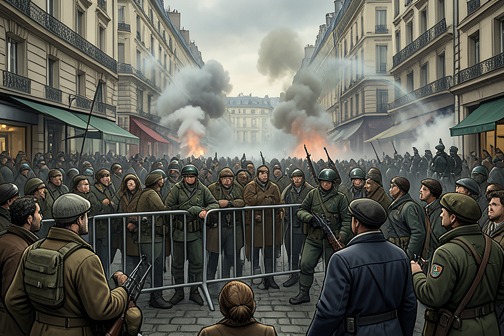
The June 1832 republican insurrection in [Paris](entity:location-recall-location-657453741ed3) turns political opposition to the [July Monarchy](entity:time-recall-time-9d8fa81851ed) into an armed confrontation and places the novel’s characters inside a crisis larger than their individual struggles. At the Rue de la Chanvrerie barricade, a small republican band waits for an assault by government troops, while the widening revolt makes the conflict between popular hopes and state power visible in the streets.
## Historical Setting and Immediate Context
The novel situates the insurrection among the events that define [France](entity:location-recall-location-4f282e1af8a7) between [Waterloo](entity:location-recall-location-86ee709f431c) and the popular uprisings of June 1832. The funeral of General Lamarque precedes the revolt in the historical chronology, and the rising is presented as a threat to the July Monarchy. Its narrated action begins on June 5, as agitation grows across Paris and a large popular disturbance is anticipated.
The insurrection also belongs to a broader account of a society in transition. The narrative’s historical overview contrasts the fading authority of aristocratic tradition with the influence of commercial and industrial wealth, while describing a laboring population burdened by poverty and exploitation. It does not reduce the uprising to a single cause, but sets it within a world where hardship and political dissatisfaction coexist with the ideals and enthusiasm associated with younger characters.
## The Barricade and the Insurgents
[Marius](entity:character-recall-character-b27b39bc4812) learns that his friends are waiting at the barricade on the Rue de la Chanvrerie. Among them are [Courfeyrac](entity:character-recall-character-courfeyrac-a6b15efc1bd2), [Bossuet](entity:character-recall-character-bossuet-227f6d793e9c), [Combeferre](entity:character-recall-character-combeferre-2d6116471147), their leader [Enjolras](entity:character-recall-character-enjolras-44fa4934383d), and [Gavroche](entity:character-recall-character-gavroche-136d0f3f2017). The appeal draws Marius into a collective struggle: the barricade is not merely the setting for a private decision, but the point at which a close circle of friends joins a wider confrontation.
As night falls, the insurgents hear only scattered, distant gunfire. The pause does not mean safety. It suggests that the government is taking time to assemble its forces, and the disparity is stark: fifty men wait against an expected sixty thousand. The detail shifts the scene from the excitement of political defiance toward the peril of an isolated group facing a much larger state response.
## Capture and the Unequal Course of the Fighting
The uprising’s military imbalance shapes what happens at the barricade. In a later phase of the fighting, the insurgents have taken uniforms from dead National Guardsmen so that married men and fathers can escape across the enemy lines. There are only four uniforms for five men. The shortage makes escape a practical, limited possibility rather than a general route to safety, and underscores the pressure on those who remain.
The barricade also exposes the presence of the police within the insurgents’ midst. After a man gives his name as [Javert](entity:character-recall-character-javert-70735fac2654), Enjolras signals four others; they seize, restrain, and search him before he can turn around. A round identification card, bearing the French arms and the designation of Javert as a fifty-two-year-old police inspector, confirms his identity. The capture makes the confrontation more than a clash between two visible forces: state authority has also entered the rebels’ ranks in disguise.
## Political Meaning and Aftermath
The insurrection’s place in the novel connects political violence with the social conditions that shape its other lives. In the account of [Jean Valjean](entity:character-recall-character-jean-valjean-4e2483d8390d)’s youth, a winter without work leaves his family without bread; his theft of a loaf is followed by conviction and a sentence of five years in the galleys. That history does not explain the uprising as a direct consequence of one character’s poverty, but it supplies a parallel view of a society in which deprivation and the machinery of punishment bear heavily on the poor.
The narrative presents the June rising as a grave challenge to the July Monarchy, and the barricade episode emphasizes the rebels’ exposure to a vastly larger government force. Its significance extends beyond the immediate battle: the collective action brings political ideals into contact with material limits, including scant numbers, scarce means of escape, and the state’s capacity to concentrate force. In 1849, Hugo would argue before the Legislative Assembly that suffering might be unavoidable while social misery could be destroyed, insisting that what was possible remained a duty. That later distinction resonates with the novel’s broader concern for the conditions beneath revolt without making the speech part of the events of 1832.
Event 5
Champmathieu affair
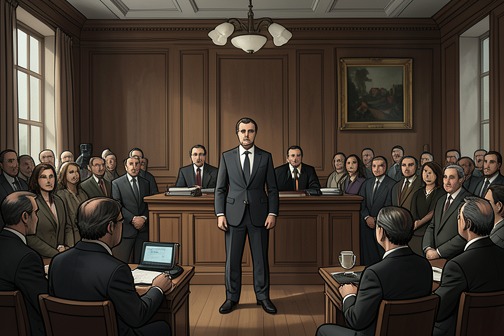
The [Champmathieu affair](entity:event-recall-event-champmathieu-affair-ac1c2af0610f) is the trial at which [Jean Valjean](entity:character-recall-character-jean-valjean-4e2483d8390d) must decide whether to let an innocent man suffer under his name or expose himself as a former convict. Its decisive reversal comes when Valjean, publicly known as M. Madeleine, enters the courtroom at [Arras](entity:location-recall-location-ffc6b06cfbb7) and identifies himself, saving [Champmathieu](entity:character-recall-character-9e560f32c445) from conviction while surrendering the security and respectability he has built.
## Background: a name mistaken for another
The affair begins when [Inspector Javert](entity:character-recall-character-42d0619167f0) admits to M. Madeleine that he has mistaken him for Jean Valjean and reported him to the authorities. Meanwhile, the police have arrested Champmathieu as the man they believe to be the real Jean Valjean; the trial is due to reach a verdict the following day. The mistaken identification turns Valjean’s concealed past into an immediate threat to someone else’s freedom.
The danger carries the weight of Valjean’s actual history. He has spent nineteen years in the galleys for theft, has been free for only four days when he recounts his circumstances to [Bishop Myriel](entity:character-recall-character-444680ba378c), and is travelling toward Pontarlier. His yellow passport marks him as a released convict. The novel’s account of former convicts explains the wider machinery behind that stigma: a passport bearing the letter F and restrictions on residence and travel made them readily identifiable, while those crossing towns had to report to the gendarmerie. Valjean’s experience of rejection at inns and refusal of shelter shows how official surveillance becomes social exclusion.
## The moral crisis
Under the name M. Madeleine, Valjean has become a respected mayor and has obligations he fears abandoning, including his promise to [Fantine](entity:character-recall-character-fantine-0b8ef69b6af0). Through the night, he struggles with the choice between preserving that life and stopping the prosecution of Champmathieu. His first response is to burn his former convict belongings. He even considers destroying the silver candlesticks given to him by Bishop Myriel, an act that would sever a material reminder of the mercy that helped shape his changed life.
The inward struggle gives the impending trial its moral force: keeping his new identity would protect his standing, but it would leave an old man to carry the consequences of Valjean’s past. The narrative frames this choice as a crisis of conscience rather than a calculation of personal advantage. After a night in which his irresolution returns, Valjean sets out for Arras.
## The courtroom reversal
At the courthouse, Valjean asks to be admitted to the hearing. Three former convicts called by the prosecution claim to recognize Jean Valjean in Champmathieu. As the accused is on the point of being condemned, M. Madeleine declares that he is Jean Valjean. The revelation overturns the identification on which the case rests: Champmathieu is acquitted, and Valjean places himself at the disposal of the police.
The reversal exposes a judicial process capable of turning a mistaken identification into the punishment of an innocent person. The novel’s broader criticism is that justice can become dehumanizing and hurried, and that penalties may be grossly disproportionate to the offenses they punish. In this case, the danger is not merely theoretical: without Valjean’s intervention, Champmathieu would have been sent to the galleys under another man’s name.
## Consequences and significance
Valjean’s self-disclosure resolves the immediate danger to Champmathieu but does not erase the force of his convict identity. Later, when speaking to [Marius Pontmercy](entity:character-recall-character-marius-pontmercy-9bc1a3cdf541), he states that he spent nineteen years in the galleys for theft, was sentenced to life for theft and recidivism, and remains in violation of his release conditions. That later account underscores the continuing legal and social vulnerability attached to his past, even after he has acted to save another man from it.
The affair makes the conflict between conscience and law concrete. Valjean’s public identity as M. Madeleine can coexist with the legal system’s claim that he is a former convict, but only until that system’s mistake places an innocent man in danger. By giving up his position rather than allowing Champmathieu to suffer in his stead, Valjean turns a concealed identity into an act of moral responsibility. The courtroom scene also reveals the limits of official judgment: in this instance, the man the authorities misidentify is the one who must intervene to prevent their error from becoming a sentence.
Event 6
June Rebellion of 1832
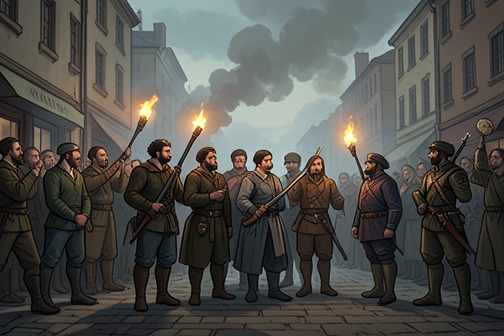
The [June Rebellion of 1832](entity:event-recall-event-1832-b77cf93035ae) brings the novel’s political history into the lives of its characters: a popular uprising against the [July Monarchy](entity:time-recall-time-9d8fa81851ed) becomes the setting for [Marius](entity:character-recall-character-b27b39bc4812)’s decision to fight, [Javert](entity:character-recall-character-javert-70735fac2654)’s exposure at the barricade, and [Gavroche](entity:character-recall-character-gavroche-136d0f3f2017)’s death under fire. The insurrection is not presented as a distant backdrop. Its imbalance of forces, improvised defenses, and human cost converge at the [Chanvrerie Street Barricade](entity:location-recall-location-eeded38afa73), where a small group faces the government’s military power.
## Background and Outbreak
The events are situated in the upheaval of June 1832. The timeline places the funeral of General Lamarque alongside the popular insurrection, while the novel’s framing identifies the uprising of June 5, 6, and 7 as a threat to the July Monarchy. In the scene that draws Marius into the action, the date is June 5: unrest is spreading through [Paris](entity:location-recall-location-657453741ed3), and an immense popular disturbance is about to break out against the regime.
The uprising connects political conflict with the novel’s wider portrait of a changing society. Its account sets the loss of older aristocratic traditions, the growing influence of commercial and industrial wealth, and the hardship of the laboring poor against the ideals and enthusiasm embodied by figures such as Marius and Gavroche. The rebellion is thus both a historical crisis and a test of what those ideals can demand from individuals when resistance becomes armed confrontation.
## Marius Joins the Insurrection
Before reaching the fighting, Marius arrives at the Paris Market District, where the streets seem unusually still and the darkness evokes the quiet of a tomb. He sits on a boundary stone and thinks of his father, Colonel Pontmercy: a soldier who had served [France](entity:location-recall-location-4f282e1af8a7) across numerous European campaigns and returned from war scarred but, in Marius’s recollection, simple and uncorrupted. His father’s example turns the approaching conflict into a personal inheritance. Marius imagines that his own hour has arrived and that he, too, must face bullets and bayonets.
But the battlefield before him is not a foreign front. It is the street, and the war he is entering is civil war. That recognition makes his resolve uneasy rather than triumphant: he sees the conflict as a gulf into which he is about to fall. A summons then directs him to the barricade on Rue de la Chanvrerie, where his friends are waiting. The voice resembles [Éponine](entity:character-recall-character-ponine-b09b7228597e)’s rough, hoarse voice, but the figure Marius sees disappearing into the dusk seems to him to be a young man. The call carries him from private grief and romantic longing into the collective danger of the insurrection.
## The Barricade and the Unequal Fight
At the barricade, [Enjolras](entity:character-recall-character-enjolras-44fa4934383d) leads a group that includes [Courfeyrac](entity:character-recall-character-courfeyrac-a6b15efc1bd2), [Bossuet](entity:character-recall-character-bossuet-227f6d793e9c), [Combeferre](entity:character-recall-character-combeferre-2d6116471147), and Gavroche. The novel measures their position against the forces gathering against them: about fifty men wait while the government takes time to assemble its strength, and the narration renders the disparity as fifty facing sixty thousand. The lull is not safety. Distant, sporadic gunfire and confused sounds suggest that the authorities are preparing to press the attack.
The barricade’s defenses are improvised, and the men’s limited resources shape the choices available to them. As the situation worsens and the insurgents face near-certain death, uniforms taken from dead National Guardsmen are used to help married men and fathers escape across the enemy lines. There are only four uniforms for five men. This practical scarcity puts family responsibility beside the political and physical stakes of resistance: even within a collective stand, some must be selected to leave while others remain.
## Javert Is Exposed
The insurgents discover that Javert is among them under concealment. When Enjolras asks his name, Javert identifies himself; Enjolras signals to four men, who seize him before he can turn, bring him down, bind him, and search him. The search confirms his identity through a small round police card set between two pieces of glass. It bears the arms of France and identifies him as a fifty-two-year-old police inspector, with the signature of the police prefect, Gisquet.
The disclosure changes the meaning of Javert’s presence at the barricade: he is not simply another man caught in the crisis but a police inspector embedded among the insurgents. The men leave his watch and purse, which contains a few gold coins, with him. The scene turns the barricade into more than a line of defense. It is also a place where identities are tested and where the rebels gain temporary power over an agent of the authority confronting them.
## Gavroche Under Fire
During the fighting, Gavroche risks himself to replenish the insurgents’ ammunition. He moves into the open, taking cartridges from pouches while soldiers and National Guardsmen aim at him. He ducks, rises, slips into doorways, vanishes and reappears, returning to the task with a basket that he fills as the defenders watch anxiously. His agility repeatedly frustrates the shooters, and he answers the volleys with songs and gestures of defiance.
That apparent invulnerability ends when a bullet hits him. Gavroche falls, then manages to sit upright, blood streaking his face; he raises both arms, looks toward the direction from which the shot came, and begins to sing. He is killed in the course of the ammunition-gathering that had made him so valuable to the barricade. His death makes the uprising’s costs immediate and intimate: the child whom society had failed to protect is also an active participant in the fight, and his courage cannot shield him from the violence surrounding him.
## Historical and Narrative Significance
The rebellion’s plot brings separate strands of the novel into one exposed space. Marius’s inherited sense of duty, the insurgents’ organization under Enjolras, Javert’s concealed identity, and Gavroche’s dangerous work all meet at the barricade. The scene’s scale is deliberately stark: a handful of defenders, a far larger force gathering beyond them, and scarce equipment between the two. The numerical imbalance makes the rebels’ position precarious before the outcome is settled.
The June uprising also anchors the novel’s account of nineteenth-century France in a particular sequence of political change, from the aftermath of [Waterloo](entity:location-recall-location-86ee709f431c) to popular revolt under the July Monarchy. By placing historical unrest beside individual decisions and losses, the narrative shows how a public crisis reaches beyond political institutions: it reshapes loyalties, forces people to choose whether to stay or escape, and turns a child’s errand for ammunition into a fatal act. The barricade’s defeat and sacrifice give the rebellion its force in the novel, where political resistance is inseparable from the lives and deaths of those who take part.
Event 7
War in the Vendée
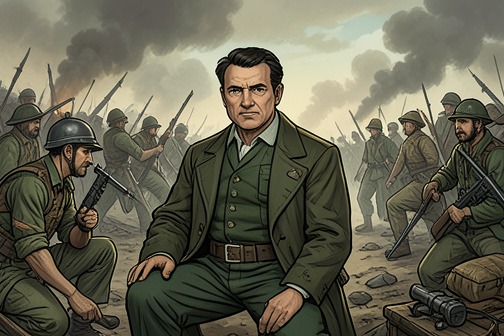
The [War in the Vendée](entity:event-recall-event-ce15fd87536b) was a civil conflict between Vendéens and revolutionaries during the French Revolution. In Victor Hugo’s Quatrevingt-treize, it supplies the historical setting for a story that turns the struggle between royalist insurgency and revolutionary authority into a conflict among characters bound by family and upbringing as well as politics.
## Historical Background
Hugo drew on the Vendée conflict as an episode of the French Revolution, a period whose political and ideological consequences remained sensitive when he wrote the novel. The war is presented not simply as a distant military episode but as a way to examine the divisions and principles associated with the Revolution and its Terror.
## Opposing Sides and Characters
The [Marquis de Lantenac](entity:character-recall-character-marquis-de-lantenac-3206e6bcea53), an aristocrat, leads the Vendéan insurrection. His nephew [Gauvain](entity:character-recall-character-gauvain-bc1aa4e592d6) has joined the people’s cause, placing the two relatives on opposing sides of the conflict. [Cimourdain](entity:character-recall-character-cimourdain-d1339526e9a7), Gauvain’s adoptive father, represents revolutionary intransigence; his political position brings a further source of tension into Gauvain’s divided loyalties.
## The Conflict in Quatrevingt-treize
Through these three figures, the novel makes the history of the Terror present in the characters’ competing commitments. In the passage described, Gauvain speaks for a republican ideal that differs sharply from Cimourdain’s inflexibility. The war’s significance in the novel therefore lies both in the opposing forces it sets against one another and in the personal relationships through which those political differences become intimate.
Event 8
Victor Hugo’s 1849 speech on eradicating poverty
[Victor Hugo’s 1849 speech on eradicating poverty](entity:event-recall-event-1849-29948273348a) turns a debate over public assistance into a test of society’s moral responsibility. Speaking to the French Legislative Assembly on July 9, 1849, Hugo argued that misery was not an unavoidable condition: where it could be abolished, leaving it untouched meant that the work of government remained unfinished. His address moves from a distinction between suffering and poverty to concrete cases of deprivation, then confronts the Assembly with the limits of order secured by political and military force.
## Occasion and proposal
The speech was delivered at the opening of a debate on a proposal by Armand de Melun. The proposal sought to establish a committee that would prepare legislation for a system of public provision and assistance. Recently elected as a deputy, Hugo spoke first. The record of the address includes parenthetical descriptions of the deputies’ responses, making the Assembly’s changing reactions part of the scene rather than presenting the speech as an argument detached from its political audience.
Hugo begins by distinguishing two conditions that might otherwise be treated as equivalent. He does not claim that human suffering can be abolished; he calls suffering a divine law. His claim is instead that misery can be destroyed. He insists that the aim is not merely to reduce or contain it, but to remove it. By comparing misery to a disease of the social body, he makes poverty a condition that can disappear rather than an inevitable feature of human life. The distinction shifts the question from whether all suffering can be prevented to whether society will act against preventable deprivation.
That distinction gives the proposed legislation an ethical measure. Hugo says lawmakers and those who govern must keep the possibility of ending misery continually in view. Until what is possible has been done, duty is not complete. The claim is more demanding than a call for benevolence: it makes the existence of preventable poverty evidence that public responsibility remains unfulfilled.
## Evidence of deprivation
To make the argument concrete, Hugo describes families living crowded together in [Paris](entity:location-recall-location-657453741ed3)’s suburbs, in streets and houses marked by severe poverty. Their bedding and coverings consist of heaps of discarded rags, and the account emphasizes that people resort to this makeshift shelter to escape winter cold. The example directs attention to deprivation within the city, where hardship is not an abstraction but a condition of family life and exposure.
Hugo then cites a recent death from hunger. The dead man was a writer, and the fact that he belonged to a liberal profession rather than a manual trade underscores Hugo’s point that poverty does not spare people according to occupation. The reported detail that he had not eaten for six days gives the claim a specific human measure. The speech also recalls a mother and her four children searching for food among refuse at Montfaucon during a resurgence of cholera in the previous month. Together, the examples extend the argument from overcrowded households to hunger ending in death and to a family seeking sustenance in conditions that expose the poor to further danger.
These cases give Hugo’s distinction between suffering and misery its practical stakes. The speech does not present the examples as isolated misfortunes beyond public concern. It declares that society must devote its strength, care, intelligence, and will to preventing such conditions. Hugo includes himself among those implicated, describing himself as sharing responsibility for them. The moral burden therefore falls not only on the people who directly endure poverty, but on the society whose institutions and members allow it to continue.
## Political order and unfinished duty
The address turns directly to the Assembly’s recent political achievement. With the support of the National Guard, the army, and the country’s forces, its members had strengthened a state that had again been shaken. Hugo acknowledges that they had defended regular society, lawful government, institutions, public peace, and civilization. He then challenges the sufficiency of that accomplishment: restoring material order is not enough if it lacks a foundation in moral order.
He measures political success against the continuing condition of the people. The work remains incomplete while people suffer or despair, while working people can be left without bread, and while the old can be without shelter after a lifetime of work. He also names usury in the countryside and hunger in the cities, and calls for laws that assist poor families, peasants, and workers. The progression connects immediate needs—food and shelter—to the broader responsibility of legislation. Public peace cannot, in his argument, be treated as a finished achievement while a part of the population lives without the means to endure.
The concluding passage sharpens the warning by linking public suffering to political danger. Hugo argues that misery can assist destructive forces, making the unhappy an involuntary collaborator with the wicked. The speech thus presents social assistance not as a secondary concern to be addressed after order has been secured, but as part of what makes order durable and morally legitimate. Its force comes from the contrast between the Assembly’s capacity to marshal national power and the unfinished task of ensuring that people do not go hungry or lack shelter.
## Place in the larger account
The speech’s concern with hunger has a pointed parallel in the account of [Jean Valjean](entity:character-recall-character-jean-valjean-4e2483d8390d)’s early life. At [Faverolles](entity:location-recall-location-faverolles-38cd00d0bdbb), Valjean’s family includes seven children and faces a winter without work or bread; Valjean takes a loaf from a baker and is sentenced to five years in the galleys. That episode belongs to the novel’s narrative, not to the Assembly speech, but it makes visible the kind of passage from destitution to punishment that gives Hugo’s political argument an immediate literary counterpart. In the earlier account, a family’s lack of bread precedes a theft treated by the courts as a crime; in the speech, hunger itself is presented as a condition for which society bears responsibility.
The published excerpt identifies the address as “La misère,” in Victor Hugo’s collected works, Actes et paroles 1, in an 1880 edition. Within the speech, the central demand remains clear: the restoration of institutions and public order does not discharge the state’s duty while preventable misery continues. The address turns that principle into a standard against which both legislation and political achievement must be judged.